22 July 2010

Britain BC

Britain BC: Life in Britain and Ireland before the Romans

Author: Francis Pryor
ISBN: 9780007126934

It has actually taken me two years to read this book. I started it in July 2008, and I remember finding it hard to comprehend. It seemed all over the place and I had difficulties with the way Pryor went into long, confusing descriptions of various archaeological dig sites. I felt extremely stupid as I just could not visualise that which he attempted to illustrate with words in detail. I became frustrated and, instead, found other books to distract.

This year I have made a concerted effort to finish those books I struggled with in the past. I picked up Britain BC again, but instead of returning to the beginning, I continued from where I had left off in order to distance myself from the earlier frustrations. It worked! I was able to read this book somewhat more comfortably and actually absorb most of the information.

The detailed and wordy descriptions of various artefacts and archaeological digs sites still left me reeling, but pictures and illustrations are provided (more frequently in the second half of the book) which help to clearly demonstrate what Pryor is tries to describe in words. In some cases, I still skipped the details in favour of understanding how the site/artefact furthered the understanding of a particular time, people, community or way of working.

Britain BC did provide me with insight in the world of archaeology; its progress over the years; and an idea of how archaeologists work today both in terms of learning about our past and in preserving it for the future. I marvelled at the amount of speculation involved in seeking to put finds into context, giving the impression that the purpose of a site or artefact can never be certain where archaeologists are involved. This was quite a lesson for me. I found it disconcerting that as Pryor dismantled the ideas of others, he sought to replace them with his own imaginings, a few of which I thought less credible than those he had just rejected. Still, what do I know?

I was taken by the idea that, immediately prior to the arrival of the Romans, British society was not necessarily a cohesive whole but rather made up of small community groups, some of which had banded together to form larger societies. Pryor also speculates that some of these communities did not have a formal structure, but were loosely banded together, and there may not have been an elite class as previously thought or imagined by rich burial sites.

Prior to reading Britain BC, I was unaware the Iron Age extended into the early part of first millennia CE with crannogs and brochs being in use in 600 CE, but only in those areas where the Romans had not tread. Although I have gained some insight into what is known about the various “ages” of prehistory, I might have assimilated more if the author had refrained from flitting between archaeological dig sites, with a quick tangent into the future of one or another site "... but we will explore that further later in another chapter" (to paraphrase) and back again. As a reader, I felt disconnected from the finds or how they corroborated what was known about the people and/or communities of the age and how they lived in the landscape. I was lost quite a bit of the time; I needed lots of breaks from reading this book in order to take my bearings. I know the author is enthusiastic - I can read it in his text - but I think more careful editing might have made the evidential information more accessible.

Overall, the book did provide me with a basic knowledge of prehistory in Britain and it's all in one place instead of the myriad of bits and bobs floating around in my head from reading news updates from various archaeological websites. I have definitely learned more than I ever did at school about the subject. It's just Britain BC is not a book I would, or even could, use as a reference to with which to check my understanding.

I am not sure what is says about the book when the first thing I can say about it is: "I now know the difference between pre-history, proto-history and history".

Rating: 4/5.

24 May 2010

Defences Against the Witches' Craft

Defences Against the Witches' Craft
Title: Defences Against the Witches' Craft: Anti-cursing Charms from English Folk Magick, Traditional Witchcraft and the Grimoire Traditions
Author: John Canard
ISBN: 9781905297184

No preaching, just practical ways of preventing and combatting curses and hexes. I only had one small quibble on a historical matter, but other than that a superb book that every witch should own.

Defences Against the Witches' Craft is a slim book packed full of useful information on charms, amulets and other ways of dealing with malefic magical forces; taken from history, but still used in modern times.  The author, John Canard, provides methods of preventing and combatting curses and hexes using a wide variety of English practices including herbs, poppets, special stones and other traditional tools.  The source of information is provided in all cases, most of which is very much rooted in England, but is supplemented by similar practices from other cultures, and a small bibliography is provided for the reader who wishes to explore further the historical uses of the various items mentioned in the book.  For the most part, it is assumed the reader has a working knowledge of magic, with step-by-step instructions provided only for a few methods.

The book is well written, in a friendly manner, and refrains from preaching on ethical matters.  I recommend this book and I am considering it as a birthday present for more than just one of my witchy friends.

Rating: 4½/5.

21 May 2010

The Mark of a Druid


Rhonda R. Carpenter has managed to pack a lot into "The Mark of a Druid".  It features England, Ireland, the United States, the past, the present, druids, christians, sovereignty, shapeshifting, prophecy, reincarnation, past life regression, hypnosis, murder and drama.

I listened to the book in audio format via the free subscription at iTunes.  The story seems slow to start and jumped quite a bit, from past to present, and between characters but, eventually, I was hooked.  Towards the end, as all the elements started to come together, the pace quickened, but the author was careful to keep you waiting for the ending you knew just had to be.

One quibble I had with the podcast format was the Rhonda R. Carpenter's reading style.  Strange punctuational pauses were distracting as was the apparently inappropriate changes in pitch giving emphasis were it was not warranted.  After a while, I noticed it less and less, with only the occasional inner query arising.   Still, it was worthwhile listening to the audio version on my commute to and from work.

I will purchase a hard copy of "The Mark of a Druid", eventually, to re-read at my leisure. I would imagine it would be a great book to take on holiday as the story is broken down into small segments, as it alternates between the past and present, thus allowing the reader to pick it up and put it down at will.

Rating:  4/5.

18 May 2010

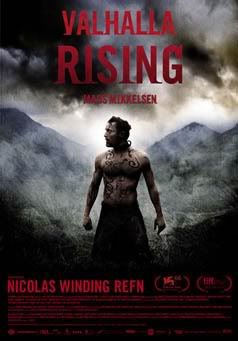
Valhalla Rising

Watched "Valhalla Rising" last night. The director refers to his movie as Viking Sci-Fi in the "Making of ..." extra. The characters don't go into outer space, so much as inner space and it's a numinous but brutal film. I found it hard to comprehend at first and I had no idea where I was being led but the journey is intense.

Mads Mikkelsen, the Danish actor (King Arthur, Clash of the Titans), plays the central character, who is mute, referred to as "One Eye", but is listed as Harald in the credits.  Scottish actors fulfill the roles of the Vikings.

The one-eyed slave is kept by a pagan clan because he is a champion in fighting tournaments. After a vision[?], the enslaved warrior finds a way to escape his captors.  After an encounter with Christians seeking Jerusalem and its riches, the journey to the promised land/Valhalla/Hel begins.

The cinematography is darkly atmospheric and the director allows the uncompromising weather of the Highlands of Scotland to add to the intensity of the characters and storyline.  The beauty of the landscape however does little to counter the violence encountered in various scenes.

Valhalla Rising is definitely a film that requires more thought than it might at first appear.  I shall definitely be viewing it again.

12 May 2010

Submissions Sought: Pagan Poetry Pages Summer 2010 Edition


The Pagan Poetry Pages are now accepting submissions for their Summer Edition. All writers of poetry and prose are invited to submit their work, either by posting on the fora at the Pagan Poetry Pages website, or by emailing the editor at editors(at)paganpoetrypages(dot)com.

Writers do not have to be pagan, but if the piece is pagan themed, or related to paganism in some way, please consider submitting your work for publication to the Summer edition of the Pagan Poetry Pages.

24 April 2010

Old v. New

Has anyone else noticed that older books on witchcraft focussed on hexing and cursing, but for the modern witch looking at books, these are rarely discussed and certainly instruction is absent?

Yet, the ability to curse, hex or work magic to the detriment of others (steal their milk, crops, lover) using foul ingredients seems to have been mainstay of the historical witch. Even love spells of old involved the use of semen, blood and urine and not always with the consent of the intended paramour. When I hear of a modern witch collecting afterbirth, hen's feet, graveyard dirt, snake skin and poisonous substances, I doubt the knowledge to know how to work with these items comes from modern books.

Nowadays, the focus of today's witchy authors seems to be on healing the self, raising protection or attracting good fortune and love, but the ingredients are now more likely to be a pretty crystal, nice incense, or an unbroken mirror (no blood, sweat, tears or toenails for the modern witch). Historically, finding lost items, reversing bad luck, providing protection were once the preserve of the cunning folk, who worked against witches, but no-one ever seems to take up that title anymore and certainly no books on becoming one (or is there?).

So what's changed? Why do modern authors stay away from the older forms of witchcraft and its ingredients, with apparently years of proven results? Why, too, are there so few books on hexes, curses and other baleful magic? Where do these modern witches working the old fashioned way get their knowledge? Why aren't these witches publishing their work for consumption by the modern witch?

31 March 2010

Call for Writers: Minority Voices in Paganism

Feel Free to Post This Elsewhere


Megalithica Books, an imprint of Immanion Press (Stafford, U.K./Portland, OR, U.S.A) is seeking submissions for an anthology on people of color working in magical communities. This anthology will be an opportunity to get the voices and experiences of minorities within the Pagan community out to the world and address some of the challenges, stereotyping, frustrations and the beauty of being different within the racial construct of typical Pagan or Wiccan groups. These communities include (but are not limited to) groups and individuals working in Wicca, Voodoo, Umbanda, Shaman, and other Pagan paths.

Many of the roots of Paganism have come from the lands of people of color yet the mainstreaming of Wicca has elevated images of worship and deity that connect with Celtic, Greek or Roman cultures. This can have an exclusive effect on those who’s culture or ancestry fall outside of those categories. Interestingly enough people of color within Paganism are often walking between the worlds of their birth ancestry and culture and that of their spiritual culture. This anthology is an opportunity to share your stories and experiences with others around being a minority in our spiritual community.

Here are some suggested topics to give you an idea of the focus of this anthology.
  • Your experience of integration into the Pagan community
  • Magical work
  • Ancestor work
  • Integrating your birth culture with your spiritual workings
  • Personal experiences and thoughts around how being of color within the Pagan community was significant.
  • What magical work are you doing now? How do you describe it? Do you work alone, in a group, or in several settings?
  • Your birth culture and spiritual workings
  • Stereotypes and prejudice
  • Being the only person of color in a coven, group or community
  • Sharing your culture and history with other Pagans
  • Cultural history
  • Sub-culture of African Americans, Hispanics or other minority groups within Wicca or Paganism.
  • Is there a sense of acceptance within the magical community you work in? Do you encounter resistance in your magical community or acceptance?
  • What do you feel is needed to be more inclusive of racial diversity in Pagan communities
Rough drafts are due July 15, 2010. These drafts will be edited in a back-and-forth process with the editor. Essays should be 1500-4000 words, although if your work falls outside those limits, do submit it – we can discuss this during the editing process. Drop us an email if you are unsure whether your idea fits into the content. The sooner you start the communication process the better, as after the deadline we won’t be considering additional ideas.

Essay requirements:
  • Citations for all quoted, paraphrased, or otherwise unoriginal material
  • Bibliography of works cited
  • Prefer APA format
Do write in your voice! If you’re academically inclined or trained, feel free to be as intelligent and technical as you like. If your work entirely talks in the first person about your own experience, please include this also. There is a wide range of voices, and we are interested in being as inclusive of style as possible.

Accepted contributors will receive a free copy of the anthology when it is published and additional copies sold at 40% off the cover price to contributors. All contributors will be provided with a contract upon final acceptance of their essays, not when they are accepted for editing. If your essay is not accepted for the anthology, we will tell you after the first round of edits.

The anthology will be edited by Crystal Blanton. She is the author of an upcoming pagan/occult nonfiction book called Bridging the Gap; Working Within the Dynamics of Pagan Groups and Society. She may be found online at http://www.crystalblanton.com and her email address for this anthology is crystal@crystalblanton.com.

Immanion Press is a small independent press based in the United Kingdom. Founded by author Storm Constantine, it expanded into occult nonfiction in 2004 with the publication of Taylor Ellwood’s Pop Culture Magick. Today, Immanion’s nonfiction line, under the Megalithica Books imprint, has a growing reputation for edgy, experimental texts on primarily intermediate and advanced pagan and occult topics. Find out more at Immanion Press.

22 March 2010

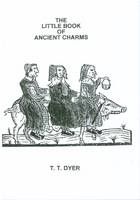
The Little Book of Ancient Charms

Author: T. F. Thisleton-Dyer
ISBN: 1901163067

This book is indeed little, being only 36 pages.  It was written in 1878 and is currently published by Oakleaf Books, in a very rough and ready manner.   The typeface is a little small for these tired eyes, but it was still an enjoyable little read.

The book covers charms for various medical conditions, as found across the British Isles.   There is a small selection of remedies given for each malady.  One particular favourite is the use of the actual hair of the dog to counteract intoxication which has been replaced, in modern times, with the imbibing of more of the alcohol that caused the complaint in the first instance.

There are footnotes should the reader wish to investigate further, but these lack detail and there is no bibliography.  

A charming read.

Rating: 3½/5. 

12 March 2010

Ha Ha Lili - Sa Dingding

Here is the latest video offering from Sa Dingding, the Chinese musician and artist whose new album, "Harmony" has just been released on CD this week. I wrote a review of her first album, "Alive" here.

The song is called "Ha Ha Lili"; the full title apparently translating to "The Story of Heaven and Earth".