22 March 2010

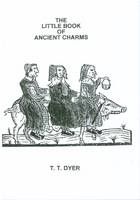
The Little Book of Ancient Charms

Author: T. F. Thisleton-Dyer
ISBN: 1901163067

This book is indeed little, being only 36 pages.  It was written in 1878 and is currently published by Oakleaf Books, in a very rough and ready manner.   The typeface is a little small for these tired eyes, but it was still an enjoyable little read.

The book covers charms for various medical conditions, as found across the British Isles.   There is a small selection of remedies given for each malady.  One particular favourite is the use of the actual hair of the dog to counteract intoxication which has been replaced, in modern times, with the imbibing of more of the alcohol that caused the complaint in the first instance.

There are footnotes should the reader wish to investigate further, but these lack detail and there is no bibliography.  

A charming read.

Rating: 3½/5. 

12 March 2010

Ha Ha Lili - Sa Dingding

Here is the latest video offering from Sa Dingding, the Chinese musician and artist whose new album, "Harmony" has just been released on CD this week. I wrote a review of her first album, "Alive" here.

The song is called "Ha Ha Lili"; the full title apparently translating to "The Story of Heaven and Earth".

07 March 2010

How to know?


I recently finished reading a book by Stuart Piggot, "The Druids" and thought the information presented therein was reasonable, discussing what is known about the historical druids, with a little rant at the modern movement beginning with the romantics. The book was written in 1974 and was a slim, paperback volume, and written in an easy to digest style.

During a discussion on some of the historical texts, I struck a problem, this paragraph:


The Druids (Ancient Peoples and Places Series)"There are two pieces of Celtic gnomic or proverbial wisdom recorded by the classical writers, and one attributed specifically to the Druids, that deserve comment here. Diogenes Laertius attributes to 'Gymnosophists and Druids' certain 'riddles and dark sayings', 'teaching that the gods must be worshipped, and no evil done, and manly behaviour maintained'. This is a statement in typically Celtic triadic form, and it is interesting to find what must be another version of it in an Irish tale, The Colloquy of the Elders, which dates from the end of the twelfth century, but may incorporate earlier material. Here St Patrick talks to one of the old pagan Celtic heroes, Caelte, and asks him: 'Who or what was it that maintained you so in your life?'; to which comes the answer, 'Truth that was in our hearts, and strength in our arms, and fulfilment in our tongues' – essentially the same three qualities in slightly different order."


I couldn't figure out how the author thought these two statements were similar in any way. I posed the question on a few forums, hoping for some answers, all the while feeling I was being stupid. So far, the responses I have had tell me I was not being stupid and the author is making a connection where there isn't one. Now, I am questioning if there are other parts of the book I shouldn't trust. But, how am I to judge? I have no background in archaeology, history, linguistics or any other field which might allow me to discern the truth. How do other, non-academic people like me manage this? I read what I can, but obviously if I can't evaluate the information critically, I might be treading down the wrong path.

I want to learn the truth, as far as we can know it today, but I am finding I am getting lost in the mire because I am unfamiliar with the landscape.

What can I do?

All suggestions welcome.

18 February 2010

A movie of "The Way of Wyrd"?

I have been listening to various podcasts on my commute to, and from work to make a long journey more interesting.   One of those to which I subscribe is Damh the Bard's "Druidcast".  

In January 2010, Episode 34 of "Druidcast" featured an interview with the author, Brian Bates,  and he mentioned working with New Line Cinema in an attempt to bring "The Way of Wyrd" to the cinema.   I hope, really hope, it goes ahead and is done well.

It seems there are a few movies, in various stages of production and pre-production, which might be of interest to pagans and heathens.  It's gratifying to see film producers looking to the old tales and reviving and/or retelling them for a younger generation which is more accustomed to MTV than reading books.   Even if these films should get the Hollywood treatment, it's still pleasing to see the resurrection of the old tales (in whatever form).   I can only hope many more myths are converted to film, tempting this former film fanatic back to the cinema.

11 February 2010

Poetry Challenge

A challenge for all poets: Write a love poem or an anti-valentine, whichever you prefer for Valentine's Day.

Post it at the Pagan Poetry Pages, with  either "Valentine" or "Anti-Valentine" in the subject line.

03 February 2010

Jillian LaDage - Music Manifesto

Back, in July 2009, I did a review of Jillian LaDage's album, "The Ancestry" here.  If you listened to it, and enjoyed it, then please read below.


February 2, 2010


To Friends and Fans of Music Everywhere,

Out of the blue I woke up this morning thinking this:-

Can we make a difference? Can we tell the media what it is we want to hear? Can a virtual unknown Celtic singer (me, Jillian LaDage) garner the attention of a music industry, so commercially focused, in one year's time from the fans?

Of course we can! Why not?! I would not be here without you.

Is this insane? Possibly.

Here is my question to you; can you add 10 friends, family members, and acquaintances as Fans on the Jillian LaDage Facebook Fan Page and the free email mailing list via Join the Tarith Cote Community on my Official Website? Can you add 50?  100?  What about the newspaper boy, the mail man, the lady in line at the post office, your neighbor down the street? What if at years’ end this page goes from 38 fans to over 5,000? What could happen? Can you imagine? Would the media and music industry take notice? Would they hear our voice? Will you join me in an experiment that lets your voice be heard and is solely directed by you, the fans?

Tell anyone and everyone from now through December 31, 2010. Let’s show the music industry what we as consumers can do. Add your friends through Facebook with a post on my fan wall saying, "(Insert name of the friend, who referred you, here) and I am in!" Copy and paste this message to your wall, emails, letters, flyers, posters, etc.  Whatever you have your hands on, use it. Got free advertising space?  Use it! Add it to your signature. The ways are endless and let’s create our own phenomenon. One powered by friends and fans of music!

Truly Yours,
Jillian LaDage
Jillian LaDage on Facebook
The Official Website

31 January 2010

"The Big Questions" - Reaction

So, I watched the programme which debated "Is Paganism more relevant today than Christianity?" on Sunday morning.  I watched it again when it appeared, in two parts on Youtube.

And, here is what I thought:  I felt completely unrepresented.

I felt that the pagan speakers were poor.  For example, none of the pagans refuted the statement that past pagans practised human sacrifice, let alone counter with the Christian God requiring Abraham to sacrifice his son, Isaac.   It was stated that paganism had no benefit as pagans were portrayed as nothing more than nature worshippers, and a non-religion, having no moral or ethical guidelines.  Well, I, for one, don't worship nature. I do have moral and ethical guidelines, not borne of a "sustainable relationship with nature", as stated by ERO, but from the society in which I live and the myths of my ancestors; the central tenet of my particular faith being "truth" (roughly translated).  Those that follow the Norse tradition have a set of strict ethical and moral codes to which they adhere, as do several other groups, including Wicca.  So, the statement that paganism is not a religion because it has no moral/ethical guidelines is false, but was weakly rebutted on the programme offering only that morals and ethics were innate.

Paganism is not a religion, it is a "hold-all" term for many different faiths, religions and philosophies, and it is impossible to refer to pagans as a cohesive whole.   Although ERO tried to explain this in relation to the question of afterlife, it was ignored and the debate continued as though all pagans have the same ideas about everything and worship or practice in the same way.   Even the opening statement fostered this impression, when Nicky Campbell announced that "Pagans will be celebrating Imbolc on Tuesday".   Really?  It was my understanding that while some pagans will celebrate Imbolc, others won't recognise the festival at all.  I laughed when the gentlemen said the statements on JF's website were contradictory. Well, of course they are, because pagans are not a cohesive whole.

However, I was appalled at the Christian-bashing, made by JF, with sweeping generalisations and misrepresentations.

There was only a brief discussion which spoke to the question of paganism or Christianity being more relevant to today's society, and Mr Harvey's contribution was reduced to the matter of environmental issues, after which I got the impression he just gave up and watched the rest of the farce.  Certainly some of the faces he was pulling (in the background) led me to this assumption.

I am beginning to see why so many are rejecting the use of the word pagan, and opting for something else instead. I must admit I tend to refer to myself as a polytheist these days.